
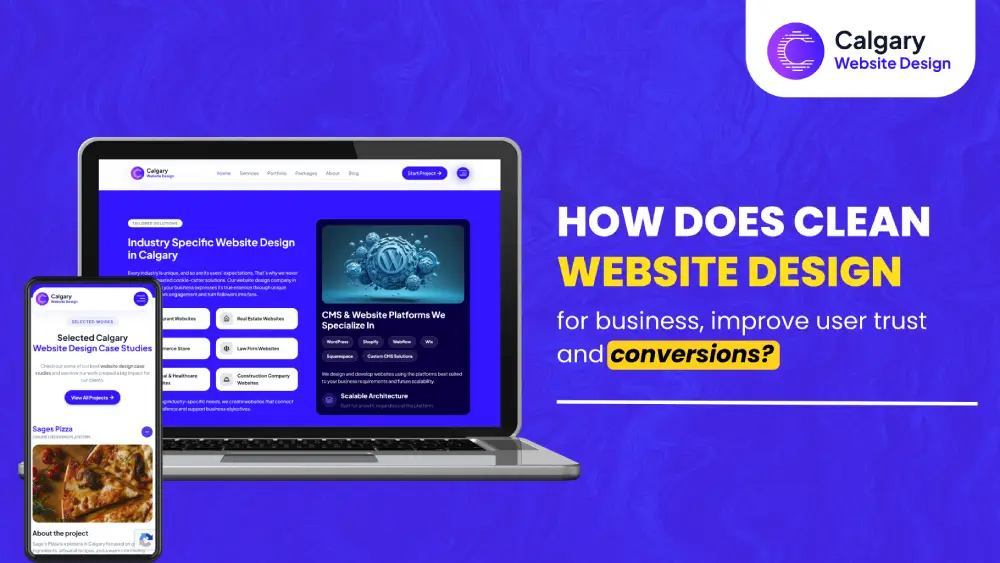
Think about the last time you landed on the website that felt cluttered, hard to navigate, or just visually overwhelming. Chances are, you left within seconds without giving the business a second thought. Now think about a website that felt smooth, clear, and easy to use. You probably stayed longer, explored more pages, and maybe even made a purchase or filled out a contact form.
That difference is what a clean website design does for a business. It is not just about looking good. It is about creating the kind of experience that makes people feel comfortable enough to trust you with their time, their attention, and eventually their money.
In this blog, we break down exactly how clean business website design builds user trust, reduces friction, and drives more conversions, backed by real data and practical insights.
You have heard the phrase “you never get a second chance to make a first impression.” On the web, that plays out faster than most people realize. Research consistently shows that users form an opinion about a website in just 50 milliseconds. That is 0.05 seconds. Before they read a single word, before they click a single button, they have already made a judgment call.
What drives that instant impression? Mostly the visual design. Crowded layouts, too many fonts, clashing colors, and poor spacing all trigger a negative gut reaction. On the other hand, a clean, well-structured page with intentional whitespace and a clear visual hierarchy feels professional and trustworthy from the outset.
According to Stanford Web Credibility Research, 75% of people judge a company’s trustworthiness based on its website design. That is three out of every four visitors making a credibility decision purely based on how your site looks and feels.
For Calgary businesses competing in an increasingly crowded digital space, that statistic is impossible to ignore.
A clean website design does not mean boring or minimal. It means intentional. Every element on the page has a purpose, and nothing exists just to fill space. Here is what a clean business website design typically includes:
Generous whitespace: Space around text, images, and elements allows the eye to rest and guides the visitor naturally through the page.
Clear typography: Readable fonts, proper hierarchy between headings and body text, and consistent sizing across all pages make content easy to scan and absorb.
Consistent color palette: Using a limited set of colors that align with your brand creates visual cohesion and avoids a chaotic feel.
Logical navigation: Menus that make sense, breadcrumbs where needed, and clear pathways through the site so visitors never feel lost.
Purposeful imagery: High-quality images that support the content and reflect your brand, rather than stock photos that feel generic.
Strong, visible calls to action: Buttons and prompts that tell the visitor exactly what to do next, placed at logical points throughout the page.
When these elements come together, the result is a website that does not just look good. It performs. Visitors know where they are, what you offer, and what to do next.
Trust is the currency of the internet. Without it, visitors will not share their contact information, make a purchase, or pick up the phone to call you. Clean website design builds that trust in several specific ways.
When a website looks professionally designed and well-maintained, it signals that the business behind it is legitimate and serious. Think about it from a visitor’s perspective: if a company cannot invest in a decent-looking website, can they really be trusted to deliver quality products or services? A Kinesis study found that 75% of people form an opinion about a business’s credibility based solely on its website design. A messy, outdated, or cluttered site raises red flags before a word is even read.
Clean design means consistent design. When your fonts, colors, button styles, and layout remain consistent across every page, it builds a sense of familiarity and predictability. Users feel more comfortable on websites that behave the way they expect. Inconsistency, on the other hand, creates cognitive friction. People start to wonder whether they’ve accidentally clicked on a different site or whether the business is disorganized. Neither of those thoughts is good for trust.
A clean design also provides proper placement and visibility for trust-building elements such as customer testimonials, certifications, security badges, and case studies. Data shows that security badges can increase conversions by up to 42%, and 61% of users will not complete a purchase if visible trust seals are absent. These elements need room to breathe and be noticed. A cluttered design buries them. A clean design showcases them.
The connection between clean website design and higher conversion rates is well-documented and measurable. Here is how it plays out across different elements of your site.
Clean design and fast loading times go hand in hand. Bloated pages stuffed with unnecessary visual elements, oversized images, and excessive scripts load slowly. And slow pages kill conversions. A one-second delay in page load time can reduce conversions by up to 7%, and websites that take over two seconds to load risk losing up to 60% of their visitors before they even see the homepage. A disciplined, clean approach to design keeps pages lean and fast, which directly protects your conversion rate.
Poor navigation is one of the biggest silent killers of website conversions. Research by the Nielsen Norman Group found that navigation issues account for 30-40% of mobile usability problems. When visitors cannot quickly find what they are looking for, they leave. Clean design prioritizes intuitive, straightforward menus that get users to the right place in as few clicks as possible. Fewer clicks and less confusion mean more conversions.
One stat that should make any business owner stop and think: approximately 70% of small businesses do not include a clear call to action on their homepage. That is an enormous missed opportunity. Clean design creates breathing room around CTAs, making them stand out naturally rather than getting lost in visual noise. When people know exactly what to do next, whether that is booking a consultation, getting a quote, or calling your office, they are far more likely to do it.
With over 58% of global web traffic now coming from mobile devices, a clean design that adapts seamlessly to smaller screens is not optional. It is essential. Mobile cart abandonment rates reach 85.65%, largely driven by a poor mobile user experience. A clean, responsive design ensures that buttons are tappable, text is readable without zooming, and the overall flow makes sense on a phone. Companies that nail this see measurable lifts in mobile engagement and sales.
Here is a number hard to argue with: for every dollar invested in user experience, businesses typically earn $100 back. That is a 9,900% return on investment. Even a modest 10% increase in UX spending has been shown to improve conversions by as much as 83%.
A Forrester Research report found that a seamless user experience can boost conversion rates by up to 200%, and a site that focuses on superior UX can achieve a visit-to-lead conversion rate that is more than 400% higher than a poorly designed site.
These are not small marginal gains. They represent transformational business outcomes driven entirely by design decisions.
Conversely, 84.6% of designers say cluttered layouts are a major mistake made by small businesses. And the consequences are real: 88% of web users say they are unlikely to return to a website after a poor experience. That means every cluttered page is not just losing a potential sale today; it’s losing a potential sale. It is losing that customer forever.
Knowing what clean design looks like in theory is one thing. Knowing where businesses actually trip up is what makes the difference. Here are the most common areas where business websites fall short.
Too much text above the fold: The area users see before scrolling should clearly and quickly communicate your core value proposition. Wall-to-wall text pushes visitors away.
Poor color contrast: Light grey text on a white background might look sleek to a designer, but it is inaccessible to many users and significantly reduces readability.
Autoplay videos and animations: These slow down load time, distract users, and often feel intrusive. They rarely improve conversion rates and frequently hurt them.
No visible contact information: Research shows that 44% of B2B buyers will leave a small business website when they cannot find contact information. Phone numbers, email addresses, and physical locations should be easy to spot.
Forms that ask for too much: Over 70% of users abandon carts or inquiry forms due to friction. Every unnecessary form field reduces the likelihood that someone will complete it.
Google pays attention to how users interact with your site. If people bounce quickly, spend little time on your pages, or rarely click through to other sections, those signals hurt your search rankings. A clean website design directly improves these engagement metrics.
When visitors find your site easy to navigate, they stay longer. They read more pages. They engage more deeply. Google interprets those behaviors as signals of a quality, relevant site. The result is better rankings, which bring in more organic traffic, creating a positive cycle.
Page speed, a direct outcome of lean design, is also a confirmed Google ranking factor. Core Web Vitals, which measure load performance, visual stability, and interactivity, are now part of Google’s ranking algorithm. Only 47% of sites currently meet Google’s Core Web Vitals thresholds. A well-executed clean design naturally ticks many of these boxes.
Calgary is a competitive market. Whether you run a law firm, a trades company, a retail store, or a professional services business, your website is often the first place potential clients research you before picking up the phone or walking through the door.
Local consumers expect more from business websites than ever before. A Google/Ipsos survey found that 88% of shoppers who search for a local business on a smartphone call or visit that business within 24 hours. But that only happens if your website gives them the confidence and clarity to take that next step.
A clean, professional business website design communicates that your business is established, trustworthy, and worth their time. It removes the doubt that causes people to click away and look at a competitor instead.
At Calgary Web Design, we have spent over seven years helping local businesses build websites that do exactly this. Our approach is rooted in purposeful design, not decoration. Every layout decision we make is tied to helping your business generate more leads, more calls, and more revenue.
The evidence is consistent and clear. Clean website design for business is one of the highest-leverage investments a company can make in its digital presence. It builds trust in seconds, keeps visitors engaged, removes barriers to conversion, and signals to search engines that your site is worth ranking.
The global web design services market is projected to reach $92 billion by 2030, and businesses that invest in professional, clean design today are the ones that will capture market share tomorrow.
If your current website feels cluttered, loads slowly, or simply does not reflect the quality of the business behind it, that is not just a design problem. It is a business problem. And it has a solution.
Whether you are building from scratch or considering a website redesign, partnering with an experienced Calgary Web Design team means getting a site that works as hard as you do, one that earns trust the moment someone lands on it and guides them confidently toward becoming a customer.
Yes, design choices directly affect your SEO performance. Page speed, mobile responsiveness, bounce rate, and time-on-site are all influenced by your design and are all factors Google considers when ranking pages. Clean, fast-loading websites with good UX tend to rank better because users engage more positively with them.
Join 5,000+ developers and founders. Get our latest engineering insights delivered to your inbox.





Quarterly insights on web performance, UX trends, and Calgary’s tech ecosystem. Zero spam.

Providing expert web design services across Alberta and the surrounding Calgary Metropolitan Area.
Local expertise blended with international corporate design systems for maximum impact.
Let's build something extraordinary together.
Studio 2115 27 Ave NE, BAY 1, Suite 201, Calgary, AB T2E 7E4
Call (403) 971-7174
Email info@cyberace.ca